
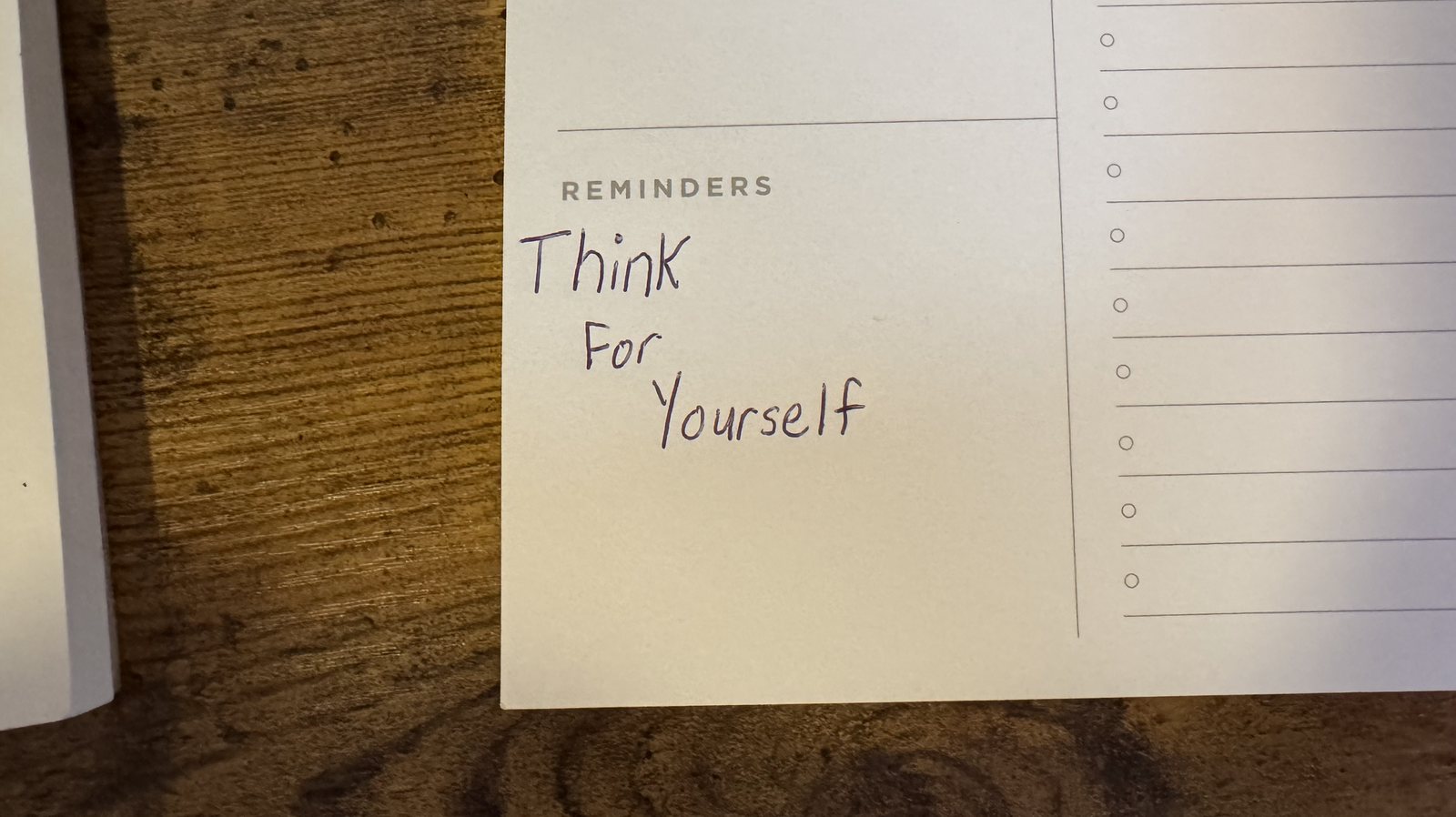
Coworkers that open Claude just to ask what time they should eat lunch, or clients that use GPT-Astra to change a SQL query from
WHERE DATE > 7/1/2026
to
WHERE DATE > 7/8/2026
People everywhere seem to be using AI in place of their brains in every aspect of their jobs and personal lives.
This is a studied fact now
I'd been feeling this for months and have had a number of conversations with friends about it, so I did the ADHD thing and hyper-fixated on it for a while. It turns out three separate research teams have done studies on this over the past 18 months, and all have come to remarkably similar results.
Microsoft Research and Carnegie Mellon surveyed 319 knowledge workers last year about how they actually use these tools at work. The more confidence people had in the AI, the less critical thinking they reported doing. The people who stayed effective and performed at a high level were the ones who trusted themselves more than the tool.
Then the MIT Media Lab put EEG caps on 54 people and had them write essays, some with ChatGPT, some with a search engine, some with nothing but their own heads. The ChatGPT group showed the weakest brain connectivity of the three, and afterwards they struggled to quote their own essays back despite the fact that they literally just wrote it moments before. The researchers called it cognitive debt - in which the test subjects borrowed against their own thinking, with "interest" coming in the form of recall inability.
Then, a study of 666 people found a significant negative correlation between frequent AI use and critical thinking, running through what the author calls "cognitive offloading". The more you hand off, the less you keep. Younger participants leaned on the tools harder and scored lower - which is a worrying signal to me for future generations (no, I'm not just a grumpy old man yelling at a cloud).
None of these studies say AI makes you dumb. They say that outsourcing the thinking makes you worse at thinking. That's a fundamentally different claim, and thankfully a much more fixable one.
What it looks like in real life
I was listening to The Daily this week, and their tech reporter Eli Tan was speaking about how he spent a couple of weeks living with Muse, the new agentic app from Meta. He gave it his credit cards, his email, his calendar, essentially his whole life (literally everything short of his work email, because he was more worried about that than his literal bank account). Within two weeks it had gotten so far into his routine that he asked it to preheat his oven for him. He had it call his local bookstore to check whether a book was in stock - while he watched the transcript of the call.
This was one of those laugh so you don't cry moments for me. It's too relatable. I see the same thing happening with people that can't make a pivot table in Google Sheets and just trust that dropping sensitive data into an LLM isn't exposing them to risk and liability.
Somebody hits a problem, and instead of sitting with it for even a minute, they go straight to Chat. And crucially, they aren't going to sharpen or augment their own thinking - they are going to replace it. The question used to be "help me pressure test what I think." Now it's "I don't know what to do, tell me what to do and I'll do it." And what comes back is confident, polished, sycophantic, and sometimes wrong, and the person asking has no way to tell, because they never formed an opinion to check it against.
I use AI every single day. Here's the difference.
I want to be clear that this isn't just me yelling from an uninformed perspective. I use Claude rather frequently. It writes the first pass of client dashboards for me. It helps me prototype tools in an afternoon that would have taken a developer a month. It runs the creative loop I've written about here before. I'm about as far from a skeptic as you can get.
The difference is where the thinking starts. AI accelerates what I'm already able to do. It is not where my ideas come from. When I have a clear point of view and I feed it into a system that helps me prototype faster, test faster, and write faster, that's an advantage I'll take every day. When I sit down with nothing and ask the robots what I should think, I've just traded the one thing that makes me useful for a slightly faster version of everyone else.
And "everyone else" is the whole problem. We're in a world now where access to knowledge is basically infinite, software costs have cratered, and the time it takes to build something has collapsed to nearly nothing. I can ship a working tool with literally just my voice and phone while on a walk (and I have done so). So can everybody. Which means knowing how to do the thing is worth a lot less than it used to be. What's left is taste. A point of view. The ability to look at ten perfectly acceptable and brand-approved options and know which one is right for this customer, this brand, this moment. You can't just slop stuff out anymore and expect it to land, because everyone's slop looks the same. It comes from the same models trained on the same internet, and the average of the internet is exactly what your competitors are shipping. (and I shouldn't have to tell you this but you really don't want the average of the internet to be your brand, please)
I see it every week in paid social. Ask AI for ten ad angles and you get ten light variations of the same shit. That's the tool doing precisely what it's built to do, which is give you the most likely answer. My job is to know that the most likely answer is the one everybody already has, and to push away from it on purpose. AI tools are fantastic at the pushing but they are useless at knowing which direction to push, because that takes a human with an opinion.
Taste is your moat. It's the one thing in your business that can't be copied in an afternoon, and it's the first thing you lose when you let the machine do your thinking for you.
So where does the taste come from?
It comes from everywhere the tools aren't, which is why I spend a significant amount of my week doing things that have nothing to do with marketing.
I go to the St. Louis Art Museum art museum basically any free chance I get. I sit down and draw and paint with my kids, and I'm truthfully very, very bad at it. That's kind of the point though. I get out into nature. I read as many different kinds of books as I can get my hands on. And I make a habit of trying new local coffee shops every single week so I can listen to what people are talking about. (Nothing has unseated Coffeestamp yet and I don't know if anything can tbh)
All of that comes from me deliberately getting out of the echo chamber, because the echo chamber is where sameness comes from, and sameness is what AI is best at producing. If I want a point of view worth feeding into these tools, I have to go build it somewhere the tools can't follow.
- Logan